Training Tip: Know Your Horse’s Gaits
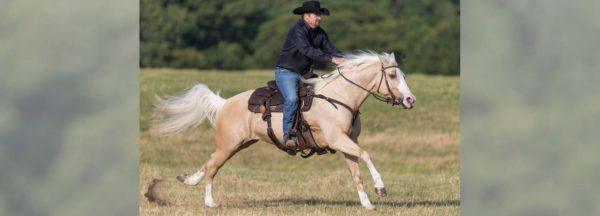
Horses have four natural gaits – the walk, the trot, the lope and the gallop. In order to be an effective rider, you must understand each gait.
Walk
The walk is the horse’s slowest gait. It’s a naturally relaxed four-beat stride with each of the horse’s feet touching the ground at four separate times. The sequence of footfalls are: Left hind, left front, right hind, right front.
Trot
The trot is a two-beat, diagonal gait. The horse’s left hind and right front foot will hit the ground at the same time, and then the left front and right hind will hit the ground at the same time. The horse moves from one set of diagonals to the other as he moves forward, with a brief moment where all four of his feet are off of the ground at the same time. The push the horse uses from his hindquarters at the trot to move himself forward is much stronger than the push he uses when he’s in the walk, and his feet move faster. When a horse trots, in order to balance himself, he’ll lift his head a little and shorten his neck compared to when he’s walking.
Lope
The lope or canter is a three-beat gait and is similar to the trot because it also contains a pair of diagonals (opposite front foot and hind foot landing together) and has a brief moment of suspension where no feet are on the ground in each stride. The lope has three distinct beats to it—one, two, three, pause. One, two, three, pause.
At the lope, the horse is either on the right lead or left lead. If the horse is on the left lead, the sequence of footfalls would be: 1) right hind, 2) left hind and right front, 3) left front followed by a moment of suspension. If the horse is on the right lead, his feet would hit the ground as follows: 1) left hind, 2) right hind and left front, 3) right front followed by a moment of suspension. If a horse changes leads, the switch occurs during the moment of suspension.
Gallop
The gallop is the horse’s fastest gait, with four beats to it. It feels similar to the lope, but the horse pushes harder, reaches farther with his legs and stays up in the air longer between strides. Unlike the lope, in which the diagonal pair of legs hit the ground at the same time, in the gallop, the hind leg hits the ground just before the front leg. At the gallop, the horse’s legs hit the ground in this pattern 1) right hind, 2) left hind, 3) right front, 4) left front.
While those are the four main gaits horses have, certain breeds of gaited saddle horses have additional gaits, such as the rack and the pace for example.
Have a horsemanship question or looking for more training tips? Check out the No Worries Club.
